
Navigating the world of chemical waste disposal can feel like a maze, but it really comes down to a clear, repeatable system: identify, segregate, and safely remove. A solid disposal program is all about following a strict, step-by-step process, ensuring you're safe and compliant from the moment a chemical becomes waste until it's properly handled.
Quick Takeaways
- Identify First: Always use the Safety Data Sheet (SDS) to determine if a chemical is hazardous and how it must be handled.
- Segregate Everything: Never mix different types of chemical waste. Incompatible materials can react violently, causing fires or toxic fumes.
- Label Clearly: Every waste container must be labeled with its contents, hazards, and the date accumulation began.
- Document Diligently: Maintain meticulous records, including manifests and training logs, to prove compliance. This "cradle-to-grave" paperwork is your legal defense.
- Partner with Pros: Always use a certified and licensed hazardous waste disposal company for transportation and final treatment.
Your Essential Chemical Waste Disposal Checklist
Getting chemical waste management right isn't just about being green; it’s fundamental to workplace safety and staying on the right side of the law. Dropping the ball here can lead to serious accidents, hefty fines, and legal headaches that just don't go away.
Think of it as a chain of custody for a critical package. Every single step has to be executed perfectly and documented, leaving no room for error.
The entire lifecycle really breaks down into three main phases. Each one has a specific job, making sure hazardous materials are managed responsibly from the lab bench to their final destination.
This simple infographic gives you a great visual of the basic three-step flow for compliant chemical waste disposal.
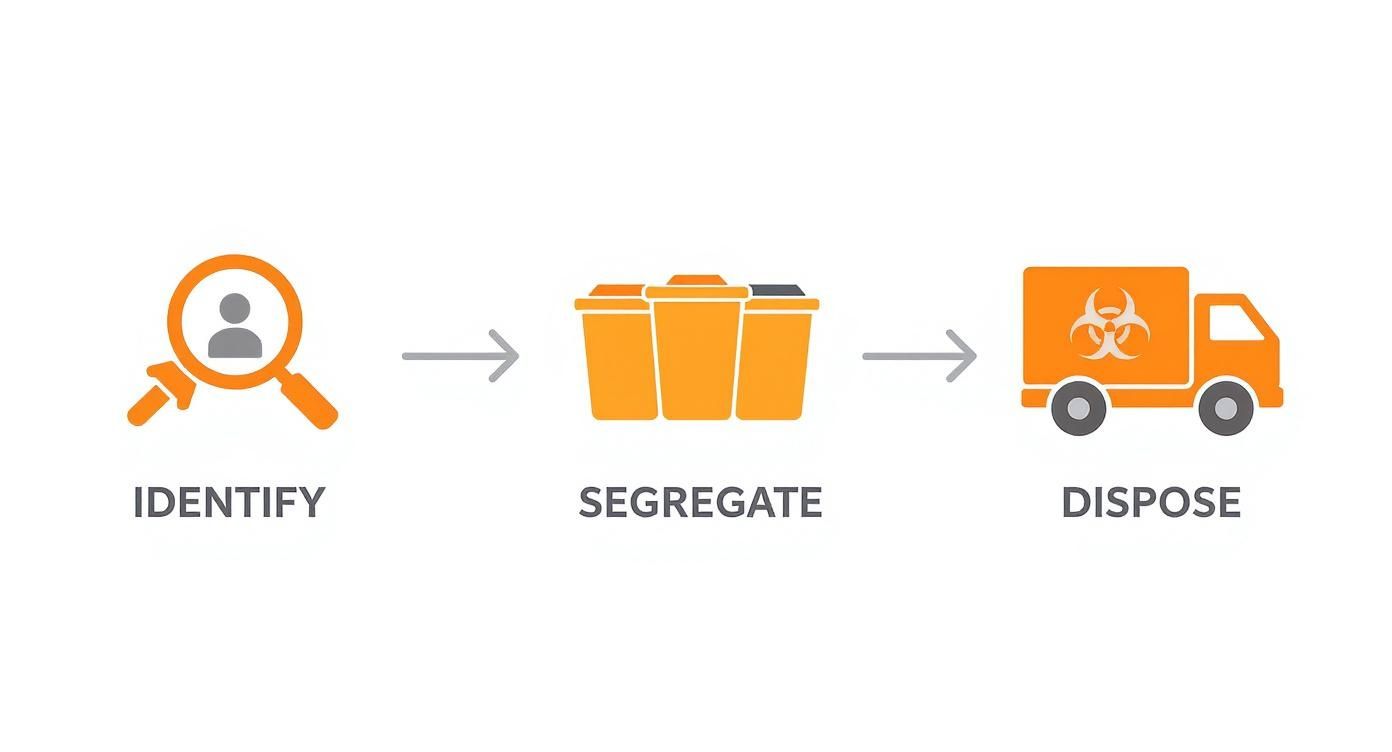
As you can see, a successful strategy kicks off with knowing exactly what you have, moves to careful separation to avoid dangerous reactions, and wraps up with professional, compliant disposal.
The Disposal Process Checklist
To help you stay organized and compliant, we've put together a step-by-step checklist. It outlines the complete journey of chemical waste, from creation to its final stop.
This table breaks down each stage, highlighting the crucial actions and the specific compliance areas you need to focus on.
Chemical Waste Disposal Process Checklist
| Stage | Key Action | Compliance Focus |
|---|---|---|
| Generation & Identification | Determine if a chemical is waste and identify its hazardous properties using its Safety Data Sheet (SDS). | EPA & OSHA regulations for hazardous waste characterization. |
| Segregation & Storage | Store waste in separate, compatible, and clearly labeled containers. Use secondary containment. | Regulations on storing incompatible materials and container labeling requirements. |
| Accumulation | Track the start date of waste accumulation and monitor quantities to stay within generator status limits. | Adherence to maximum accumulation times and volume thresholds. |
| Documentation & Manifest | Prepare a hazardous waste manifest for shipment, accurately detailing waste codes, quantities, and handler info. | Department of Transportation (DOT) and EPA manifest requirements. |
| Transportation & Disposal | Schedule pickup with a licensed hazardous waste hauler for transport to a permitted facility. | "Cradle-to-grave" liability; ensuring the final disposal method is compliant. |
| Record Keeping | Retain all manifests, disposal certificates, and related documents for a minimum of three years. | Proof of compliance for potential audits by regulatory agencies. |
Following this checklist will help you build a more robust and defensible program. For a deeper look into the principles behind these steps, check out our guide on waste management best practices.
How to Correctly Identify Chemical Waste
Before you even think about disposal, you have to know exactly what you’re dealing with. Getting chemical waste identification right is the first, and most critical, step. It dictates everything that comes after, from how you store it to how it’s ultimately treated.
A simple misidentification isn't just a paperwork headache. It can lead to dangerous chemical reactions, serious environmental damage, and hefty regulatory fines.
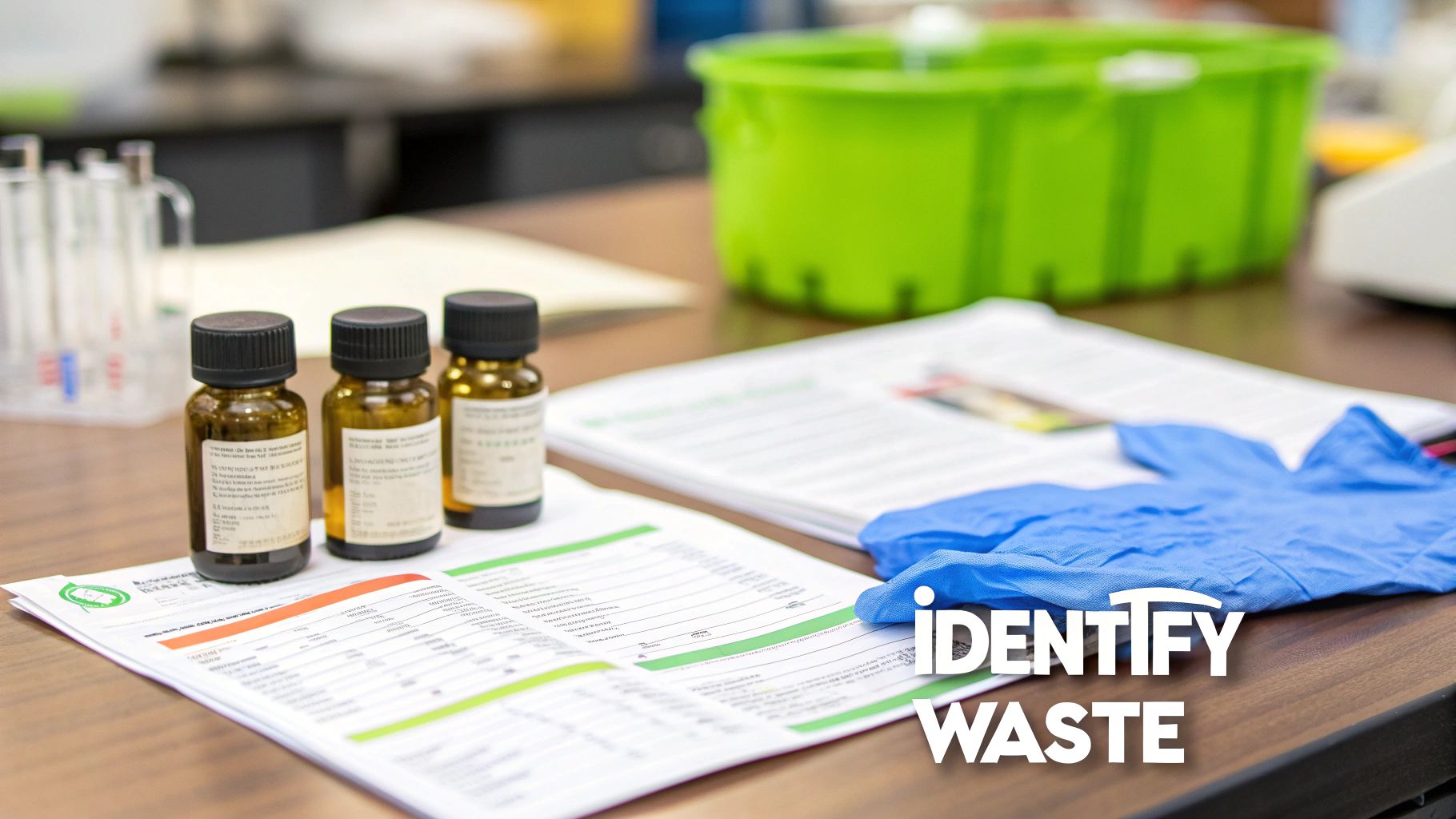
Think of it like sorting your recycling at home. You know not to toss glass in with the paper because they're processed differently. Chemical waste is infinitely more complex and dangerous, making that initial sorting an absolute must for safety. The whole process really boils down to understanding the primary hazard categories.
The Four Main Hazardous Waste Categories
Most hazardous chemical waste will fall into one of four buckets, each defined by its specific characteristics. Knowing these helps you quickly size up the risks.
- Ignitable: This is anything that can easily catch fire. We're talking about common items like spent solvents (acetone, ethanol), paint thinners, and some adhesives. If it has a flashpoint below 140°F (60°C), it's in this category, meaning it can ignite under pretty normal conditions.
- Corrosive: This group includes highly acidic or basic materials that can chew right through metal containers or cause severe burns. Old battery acid (sulfuric acid) or industrial-strength cleaners with sodium hydroxide are perfect examples.
- Reactive: These wastes are the unstable ones. They can explode, give off toxic fumes, or react violently when they get wet. A notorious example is picric acid, which can become explosive as it ages and dries out.
- Toxic: These are substances that are harmful or even fatal if swallowed or absorbed. It's a wide category that covers waste with heavy metals like lead or mercury, pesticides, and many lab reagents.
Nailing the classification of your waste into these groups is a foundational first step. To get a better picture of what happens after these materials leave your site, you can check out our detailed guide on the hazardous waste management process.
Using the Safety Data Sheet (SDS) for Identification
The single most valuable tool in your arsenal for identifying chemical waste is the Safety Data Sheet (SDS), which you might remember as the Material Safety Data Sheet (MSDS). Chemical manufacturers are legally required to provide an SDS for their products, and it's packed with all the information you need for safe handling and disposal.
An SDS is a standardized document with 16 sections. For waste identification, you’ll want to zoom in on a few key areas:
- Section 2 – Hazard Identification: This gives you a quick summary of the chemical’s hazards and shows you the labels and pictograms you should see on the container.
- Section 9 – Physical and Chemical Properties: Here’s where you’ll find the hard data, like flash point and pH. This section tells you directly if the waste is ignitable or corrosive.
- Section 10 – Stability and Reactivity: This part lists any conditions to avoid—like contact with water or other chemicals—which is essential for spotting reactive waste.
- Section 13 – Disposal Considerations: This section provides specific guidance on proper disposal, helping you stay aligned with regulations from the get-go.
The SDS isn’t just another piece of paper; it’s your compliance roadmap. When you treat it as the ultimate source of truth for a chemical's properties, you ensure that every bit of waste is identified correctly, stored safely, and disposed of properly.
To truly get ahead of the game, it's best to conduct a thorough chemical risk assessment guide before a substance even becomes waste. By systematically using the SDS and understanding the four main hazard categories, you build a rock-solid foundation for a safe and compliant chemical waste program.
Navigating Chemical Waste Disposal Regulations
Properly handling your chemical waste isn’t just about ticking boxes on a checklist; it's a core business function that shields you from some pretty severe legal and financial pain. Drop the ball on environmental regulations, and you could be looking at crippling fines, operational shutdowns, and a black eye on your company's reputation. This whole framework exists for one reason: to make sure hazardous materials are managed safely from the moment they're created to the second they're destroyed.
The web of local, state, and federal laws can look intimidating. But once you peel back the layers, you’ll find it’s all built on a single, powerful concept. Grasping this principle is the key to building a compliance record that can stand up to any scrutiny.
The Cradle to Grave Responsibility
In the United States, the Environmental Protection Agency (EPA) calls the shots on hazardous waste through the Resource Conservation and Recovery Act (RCRA). The absolute heart of RCRA is the "cradle-to-grave" system. This isn't just a catchy phrase—it's a legal mandate that makes you, the waste generator, responsible for your hazardous materials from creation ("cradle") until their final, documented destruction ("grave").
Think of it like a legal chain of custody for a critical piece of evidence in a court case. Your responsibility doesn't magically vanish when the disposal truck pulls out of your driveway. If your vendor messes up and illegally dumps that waste, your company can still be held liable for the cleanup costs and fines. This is exactly why vetting and choosing a certified, reputable disposal partner is non-negotiable.
Your legal liability for chemical waste is permanent. The cradle-to-grave principle means you are accountable for the entire lifecycle of your hazardous materials, regardless of who transports or treats them.
This isn't just an American idea; its core principles are echoed in environmental laws all over the world. As chemical waste streams have become more complex, a massive global industry has sprung up to manage them. By 2025, the global market for hazardous waste management is projected to hit around $41.25 billion, a number that screams just how urgent and specialized this work has become. You can explore more data on this expanding market to see the economic forces at play.
Real-World Consequences of Non-Compliance
The penalties for slipping up aren't just abstract threats on a government website. They are real, they are costly, and they hit businesses of all sizes. Let's walk through a couple of realistic (and anonymized) scenarios to see how things can go sideways.
Case Study 1: The Mislabeled Drums
A manufacturing plant accidentally slapped "non-hazardous" labels on several drums of flammable solvents. The disposal company, working with bad info, mixed them with other materials at their facility. The result? A nasty chemical reaction and a major fire.
- Outcome: The manufacturer was found liable for all cleanup costs, property damage, and got hit with heavy EPA fines for improper waste identification. Their cradle-to-grave responsibility meant they were on the hook, even though the fire happened miles away from their site.
Case Study 2: The Improper Storage
A research lab let corrosive waste sit around for more than the legal 90-day limit for their generator status. During a routine state inspection, an auditor found the outdated, improperly sealed containers.
- Outcome: The lab was fined immediately and forced into a costly corrective action plan. This included mandatory staff retraining and a complete facility-wide audit, not to mention the damage to their reputation in the research community.
These stories hammer home a critical point: compliance is an active, hands-on process. It demands obsessive attention to detail every single step of the way.
Key Regulatory Pillars to Uphold
To stay out of hot water, you need to build your program on three critical pillars. Get these right, and you'll have a strong, defensible chemical waste management system.
- Accurate Waste Characterization: It all starts here. You must correctly identify and classify every single waste stream you generate. This one step dictates every handling, labeling, and disposal decision that follows.
- Meticulous Record-Keeping: If you didn't document it, it didn't happen. You need to keep up-to-date chemical inventories, log accumulation start dates on every container, and hold onto your hazardous waste manifests for at least three years.
- Proper Training: Anyone who touches your hazardous materials needs to be trained on safety protocols, proper storage, and what to do in an emergency. This training has to be documented and refreshed regularly to meet both OSHA and EPA standards.
Comparing Chemical Waste Treatment Methods
Once you've identified and segregated a chemical, the million-dollar question is: how do you make it safe? The world of chemical waste disposal isn’t just about tossing things out. It's a highly scientific field dedicated to neutralizing threats and protecting our environment. Think of it like a doctor prescribing different treatments for different illnesses—you have to match the solution to the problem.
The scale of this challenge is staggering. As industries have grown, so has our output of hazardous materials. As of 2023, the world generates a mind-boggling 400 million tons of hazardous waste each year. That’s almost 13 tons every single second. Huge sectors like chemical manufacturing and petroleum production are the main drivers, which makes having effective treatment methods more crucial than ever.
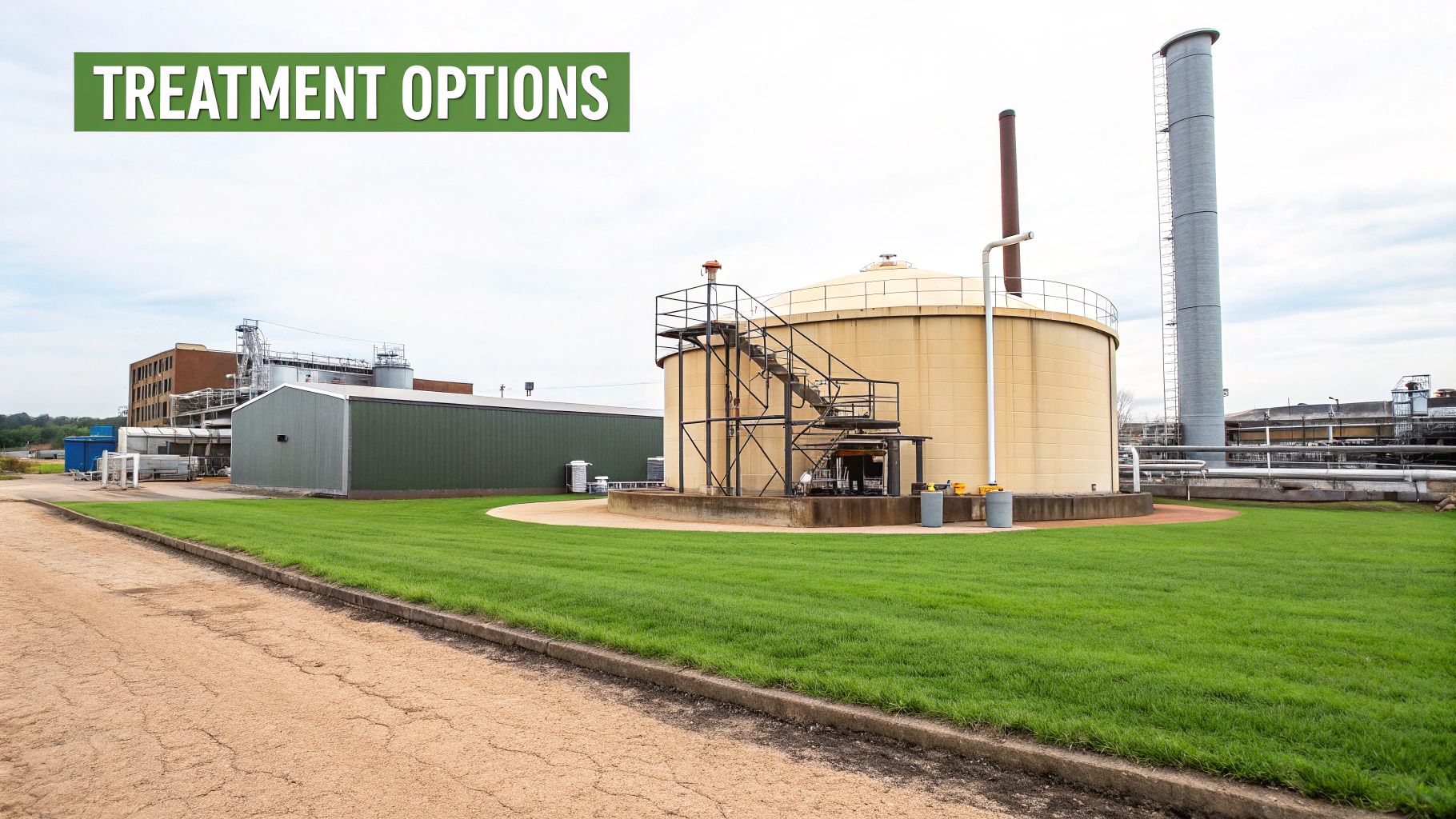
Getting a handle on the primary treatment and disposal methods will help you have more productive conversations with your disposal vendors and truly appreciate the tech that keeps our planet safe.
Thermal Destruction Through Incineration
Incineration is way more sophisticated than just setting waste on fire. Picture a highly specialized, super-hot furnace engineered to systematically tear harmful molecules apart. This method uses controlled combustion at blistering temperatures, often topping 1,800°F (1,000°C), to break down hazardous organic compounds into much less harmful substances like carbon dioxide, water, and ash.
This process of thermal destruction works wonders on many toxic organic wastes, such as solvents, pesticides, and certain industrial sludges. Modern incinerators aren't just furnaces; they're complex systems loaded with advanced pollution controls like scrubbers and filters. These additions are designed to catch and neutralize nasty byproducts before they ever hit the atmosphere. For a closer look at the mechanics, you can explore the science behind medical waste incineration, which operates on very similar principles.
Chemical Neutralization and Treatment
Some chemical wastes, especially corrosive acids and bases, can be disarmed using other chemicals. The most common technique is neutralization, which is a bit like balancing a seesaw. An acidic waste stream gets treated with a basic (alkaline) substance, or vice versa, until its pH level reaches a neutral state around 7.0—just like pure water.
Other chemical treatments are also in the toolkit:
- Precipitation: This technique converts dissolved hazardous materials, like heavy metals, into a solid form. Once solid, they can be easily filtered out of the liquid waste.
- Oxidation/Reduction: These are chemical reactions used to transform toxic substances into less dangerous ones. For instance, chemical reduction can turn highly toxic hexavalent chromium into the far less harmful trivalent chromium.
These methods often serve as a pre-treatment step, reducing the hazard level of a waste stream before it moves on to its final disposal.
Secure Landfilling and Deep Well Injection
What happens when waste can't be burned or treated with chemicals? That's where secure landfilling often comes in. But this is not your typical city dump. A hazardous waste landfill is a masterfully engineered containment facility built to completely isolate waste from the outside world. It has multiple layers of impermeable liners, sophisticated leak detection systems, and groundwater monitoring wells to prevent any chance of contamination.
For certain types of liquid hazardous waste, there’s another option: deep well injection. This process involves pumping the waste into porous rock formations deep underground, far below any aquifers or drinking water sources. As you can imagine, this method is strictly regulated and is only suitable for specific geological locations and particular waste types.
The ultimate goal of any disposal method is permanent isolation or complete destruction. Whether it's through heat, chemistry, or physical containment, the aim is always the same: ensure hazardous materials can no longer harm people or the planet.
A Comparative Look at Disposal Methods
Choosing the right disposal method is a balancing act. It all depends on the waste's chemical properties, what the regulations demand, and, of course, the cost.
The table below gives a quick overview of the main disposal techniques, helping to clarify the pros, cons, and best-use cases for each one.
Comparison of Chemical Waste Disposal Methods
| Disposal Method | Best For | Advantages | Disadvantages |
|---|---|---|---|
| Incineration | Organic compounds, solvents, medical waste | Drastically reduces waste volume; destroys pathogens and toxins. | High operational cost; potential for air emissions if not controlled. |
| Chemical Treatment | Corrosive and reactive wastes, heavy metals | Can render waste non-hazardous; often cost-effective. | Not suitable for all waste types; may produce sludge that needs disposal. |
| Secure Landfill | Solidified inorganic wastes, ash from incineration | A secure final disposal option for untreatable waste. | Requires long-term monitoring; potential for leaks if not maintained. |
| Recycling/Recovery | Solvents, oils, certain metals | Environmentally friendly; conserves resources and reduces waste. | Limited to specific, non-contaminated waste streams. |
Ultimately, having a solid grasp of these options allows for smarter, safer, and more compliant waste management decisions.
Best Practices for On-Site Waste Management
Proper chemical waste disposal doesn’t just start when the truck shows up for a pickup. Far from it. The real work begins with the daily, on-the-ground practices inside your facility that keep risks low, your team safe, and your compliance record airtight. Good on-site management isn't just about ticking boxes on a checklist; it’s about fostering a deep-rooted culture of safety and responsibility.
Getting these practices right is critical, particularly when it comes to the safe handling of hazardous drugs in laboratories, where the goal is to reduce hazards long before anything is marked for disposal. This forward-thinking approach is your best defense, protecting both your people and your business from regulatory headaches.
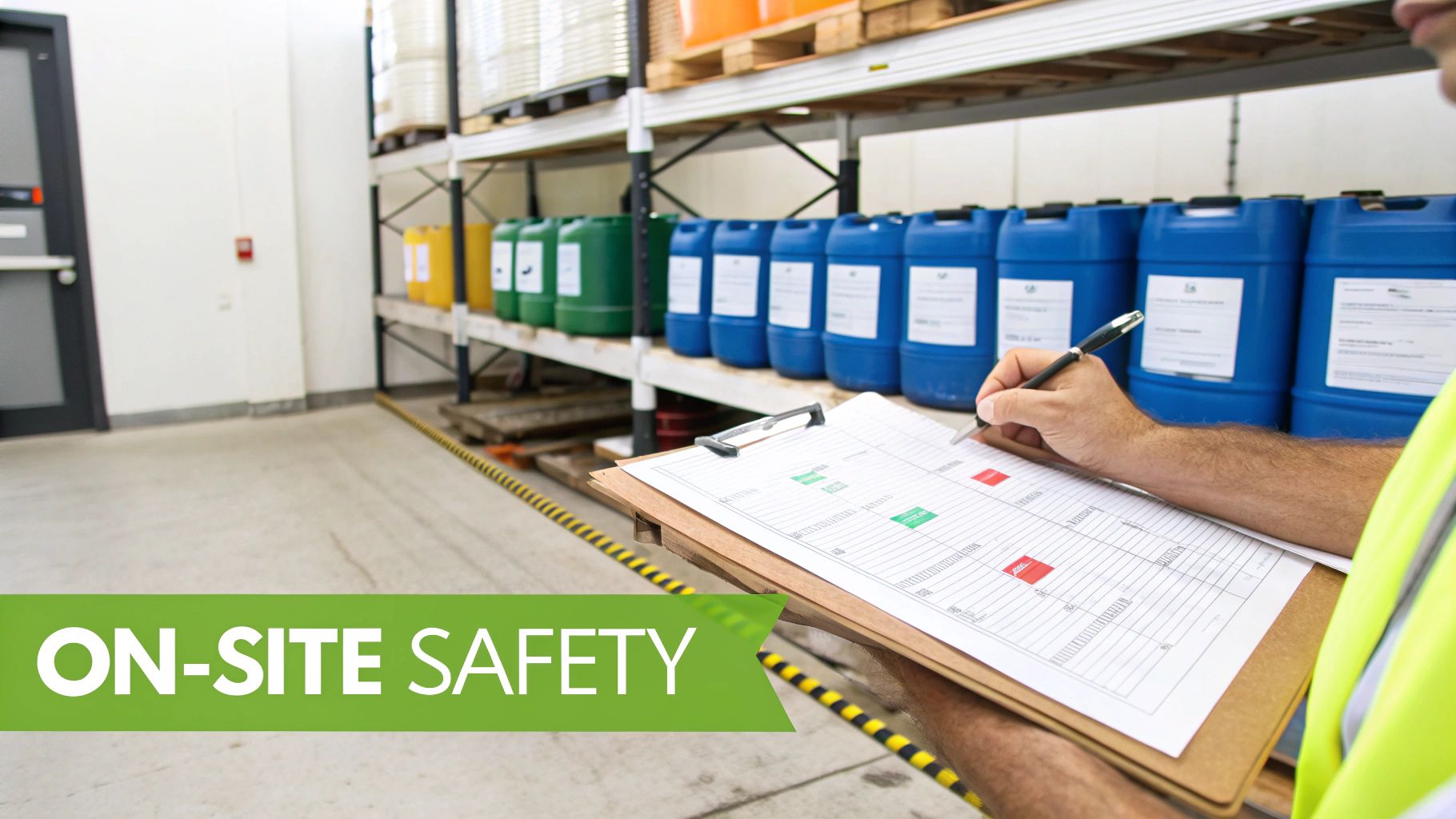
The amount of chemical waste being generated is staggering. The global market for managing it hit $15 billion in 2023 and is projected to climb to $23.7 billion by 2032. Consider this: chemical production has exploded by 40,000% in a single generation. This context makes it crystal clear why solid, on-site protocols are more essential now than ever.
Proper Segregation and Storage Protocols
The absolute foundation of on-site management is keeping incompatible chemicals separated. It's a simple rule, but ignoring it can lead to disaster. Mixing the wrong waste streams can cause violent reactions, spew toxic gases, or even start fires.
- Separate by Hazard Class: This is non-negotiable. Never store acids with bases. Keep oxidizers far away from flammables. Your Safety Data Sheet (SDS) is your guide here—use it to map out designated storage zones for each hazard category.
- Use Secondary Containment: Think of this as a safety net. Every container of liquid waste should sit inside a larger, leak-proof tub or tray. If a container fails, the spill is caught before it becomes a major incident.
- Maintain a Designated Area: Your waste storage area needs to be a fortress. It should be secure, well-ventilated, and clearly marked with the right signage. Critically, it must be located away from drains and out of high-traffic areas.
Labeling and Documentation: The Unbreakable Chain
Vague or missing labels are a recipe for trouble. An unlabeled container isn't just a compliance issue; it’s a massive safety risk for every single person who might come into contact with it. Every waste container must be labeled the moment the first drop of waste goes in.
A compliant label must include:
- The words “Hazardous Waste”
- The full chemical names of everything inside
- The specific hazards (e.g., Ignitable, Corrosive)
- The accumulation start date—the day you first added waste
This practice creates a clear, unbreakable paper trail. Think of the hazardous waste manifest, the document that travels with your shipment, as the high-stakes shipping manifest for a dangerous package.
The manifest is a legally binding document that tracks your waste from your door to its final disposal site. Incomplete or inaccurate manifests are a fast track to hefty fines and are a major red flag to auditors about your on-site practices.
Meticulous Record-Keeping and Regular Inspections
When an auditor walks through your door, your documentation is your first line of defense. Keeping organized, up-to-date records is how you prove you're taking your responsibilities seriously.
You need to maintain meticulous records of:
- Waste Inventories: A live log of all hazardous waste currently stored on-site.
- Inspection Logs: Proof of weekly inspections of your storage areas, checking for leaks, correct labeling, and container damage.
- Training Records: Documentation showing that every employee handling hazardous materials has completed all required safety training.
- Disposal Manifests: You are required by the EPA to keep copies of all hazardous waste manifests for a minimum of three years.
By embedding these practices—segregation, clear labeling, and detailed record-keeping—into your daily operations, you build a safe, compliant environment that’s always ready for inspection.
How to Choose a Disposal Partner
Picking the right partner for your chemical waste disposal is one of the most critical decisions you'll make for your business. It's not just about getting waste hauled away. Thanks to the EPA's "cradle-to-grave" principle, your legal liability doesn't end when the truck pulls out of your driveway. You are permanently tied to that waste, which makes choosing a qualified and trustworthy vendor a non-negotiable risk management strategy.
Think of it like hiring a specialized surgeon. You wouldn't just pick the cheapest option or the first one you find online. You'd check their credentials, their experience, and their track record. The same level of due diligence applies here, because a mistake made by your partner can have very real legal and financial consequences for you.
Verifying Core Credentials
Before you even start talking about services or pricing, you have to confirm that any potential vendor meets the absolute baseline legal requirements. This initial check is your first line of defense, separating the legitimate operators from those who could put your business in jeopardy.
There are three non-negotiable areas you must verify right away.
- EPA/State Certifications and Permits: This is the big one. The vendor absolutely must hold all the necessary permits from the Environmental Protection Agency (EPA) and your specific state's environmental agency. Don't just take their word for it—ask for their EPA ID number and to see copies of their permits for transportation, storage, and disposal.
- Comprehensive Insurance Coverage: Accidents can and do happen. Make sure the company carries significant liability insurance, specifically asking about pollution liability and environmental impairment coverage. This is what protects you if a spill or accident occurs while your waste is in their hands.
- A Clean Compliance History: How a vendor has performed in the past is the best predictor of their future reliability. Use the EPA's public databases to check their compliance history. Look for any patterns of violations, fines, or enforcement actions. A history of non-compliance is a massive red flag.
Choosing a disposal partner isn’t a simple vendor transaction; it's an extension of your own compliance program. Their performance, good or bad, directly reflects on your business and its commitment to environmental stewardship.
Key Questions for Your Vetting Process
Once you've confirmed a vendor has the right credentials, it’s time to dig deeper into how they actually operate. Treat this stage like a job interview. You need to ask pointed questions to understand their processes, especially for handling worst-case scenarios and managing the documentation that ultimately protects you.
Here’s a practical list of questions to get the conversation started:
- Final Disposal Methods: Where does our waste actually end up? Do you own the final disposal site, like an incinerator or landfill, or are you using third-party facilities? If so, who are they?
- Documentation and Record-Keeping: What's your process for managing hazardous waste manifests? More importantly, how quickly will we get the final, signed copy for our records? (The answer should be "fast.")
- Spill Response Protocol: What is your emergency response plan if there's a transportation spill? Do you have your own dedicated response team, or do you subcontract that out?
- Waste Tracking Technology: Do you use any digital systems, like barcode scanning or GPS tracking, to monitor waste from the moment it leaves our facility to its final disposal?
A reputable, professional partner will have clear, confident answers to these questions. They won't hesitate or give you vague responses. Their ability to provide detailed, transparent information is one of the best signs you're dealing with a reliable operation. Taking the time to properly vet your disposal partner is an investment that pays for itself many times over in safety, compliance, and simple peace of mind.
Frequently Asked Questions (FAQs)
What are the most common chemical waste disposal mistakes?
The most frequent errors involve improper labeling, mixing incompatible waste streams, and inaccurate paperwork. Mislabeling or failing to label a container is a major safety and compliance risk. Mixing incompatible chemicals can cause dangerous reactions. Finally, errors on the hazardous waste manifest can lead to significant fines.
How often should my facility schedule a waste pickup?
This depends on your EPA generator status (Very Small, Small, or Large Quantity Generator), your rate of waste generation, and your on-site storage capacity. Each generator status has strict limits on how much waste can be accumulated and for how long. It's best to schedule pickups well before you approach these limits to ensure continuous compliance.
Can I throw small amounts of chemical waste in the regular trash?
No. It is illegal and unsafe to dispose of any amount of regulated hazardous waste in the regular trash. Under the EPA's "cradle-to-grave" liability, you are responsible for the waste from its creation until its final destruction. Even a small amount improperly disposed of can lead to significant fines and environmental harm.
What is a hazardous waste manifest?
A hazardous waste manifest is a multi-part legal document required by the EPA that tracks the movement of hazardous waste from the generator's site to its final destination. It serves as a chain-of-custody document, ensuring the waste is handled properly at every step. You must keep a signed copy of the manifest for at least three years as proof of compliant disposal.
At Waste Corner, we connect you with the resources and expertise you need to manage your environmental services with confidence. Dive into our directory and articles to find trusted partners and practical insights for all your chemical waste disposal needs.